When you walk into a wedding hall in Tamil Nadu, the first thing that hits you isn’t the music or the food—it’s that unmistakable rustle of silk. In our homes, a Pattu saree isn’t just “expensive clothing”; it’s an emotion passed down from mothers to daughters, often carrying the scent of sandalwood and memories of old steel trunks. From the heavy, majestic drapes of Thirubuvanam silks to the simple elegance of a Salem silk dhoti, these weaves are the heartbeat of our traditions.
To the untrained eye, they might all look like shimmering silk, but if you look closer, every border, every zari thread, and every “Butta” tells a story about the town it came from and the weaver who made it.
Types of Pattu Sarees
Geographic Origin:
Let’s take a look at the different types of Pattu sarees based on the famous weaving towns and regions they come from.
1. Kanchipuram Pattu
The “Queen of Silks,” these sarees are woven in the temple town of Kanchipuram. They are world-renowned for their durability and weight. A genuine Kanchipuram uses three plies of silk thread twisted together with silver wire, making the fabric thick and sturdy. The most distinguishing factor is the Korvai technique, where the border and body are joined in a contrasting, serrated pattern.
2. Thirubuvanam Pattu
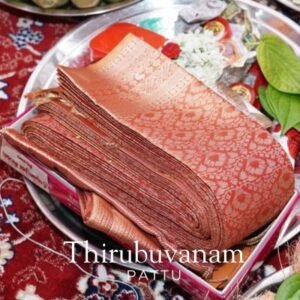
Thirubuvanam Pattu is a hidden gem from the Tanjore region, famous for using high-grade filature silk that gives the fabric a natural, mirror-like gloss. These sarees are quite heavy, often weighing up to a kilo because of the dense silk and rich zari work. What really sets them apart is the “single-side” folding style; instead of a flat fold, they are fanned out like an Angavastram called “Visirimadipu” to protect the intricate gold thread and traditional motif designs from creasing. The pallu is the star here, featuring incredibly detailed designs that are meant to be draped in a way that shows off the weaver’s technical skill.
3. Arani Pattu
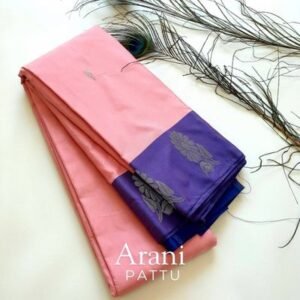
Produced in the Thiruvannamalai district, Arani sarees are the preferred choice for those who find Kanchipuram too heavy. They are lightweight and use a single or double warp. Arani is famous for the “Two-Side” border design, offering two different looks in a single drape, making it highly versatile for festive wear.
4. Rasipuram Pattu
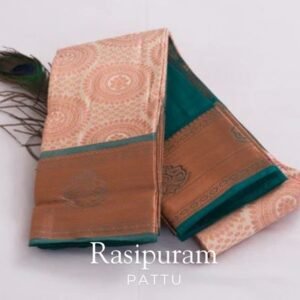
For those who prioritize comfort without sacrificing the silk look, Rasipuram is the answer. These are essentially “Soft Silks.” They have a lower density of zari, making them easy to drape and carry for long hours at weddings or corporate events.
5. Banarasi Pattu
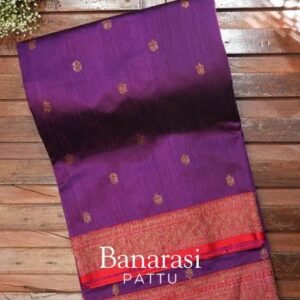
Originating from the holy city of Varanasi, these are among the finest sarees in India. They are famous for their Mughal-inspired designs, such as intricate floral patterns (Kalga and Bel) and a string of upright leaves called Jhallar. The silk is extremely soft, but the saree is heavy due to the extensive use of gold and silver brocade work.
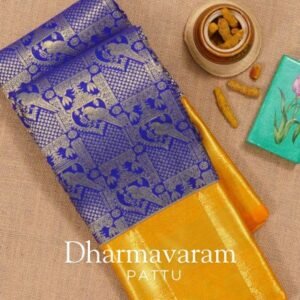
6. Dharmavaram Pattu
Known as the “Silk City of Andhra Pradesh,” Dharmavaram produces sarees that are a staple for South Indian weddings. These are distinguished by their double-shade (two-tone) effect, created by weaving two different colors of thread into the warp and weft. They feature broad borders with temple designs and rich pallus depicting local art.
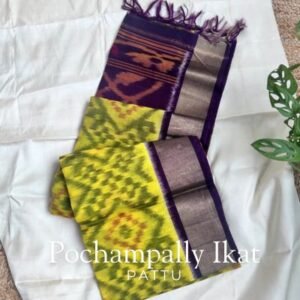
7. Pochampally Ikat
These sarees are famous for the “Chitti” or Ikat weaving technique, where the threads are tie-dyed before weaving to create sharp, geometric patterns. Unlike the floral motifs of other Pattu sarees, Pochampally is known for its modern, mathematical precision and vibrant, contrasting colors. It is generally lighter and more comfortable for long events.
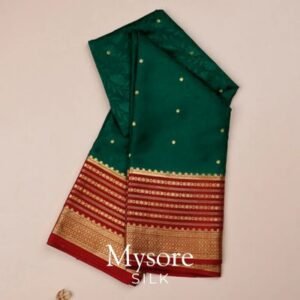
8. Mysore Silk Saree
Mysore silk is the most minimalist and elegant form of Pattu. Produced by the Karnataka Silk Industries Corporation, these sarees use 100% pure silk and genuine gold zari. They are usually plain, single-color sarees with a simple “lace” border. The fabric is incredibly soft, fluid, and drapes like a second skin.
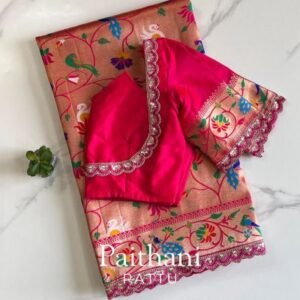
9. Paithani Pattu
Often called the “Queen of Maharashtra,” the highlight of a Paithani is its kaleidoscopic border and a pallu featuring motifs like peacocks (mor), parrots (tota), and lotuses. They are hand-woven with a specialized technique where the design looks exactly the same on both the front and back of the fabric.
10. Gadwal Pattu
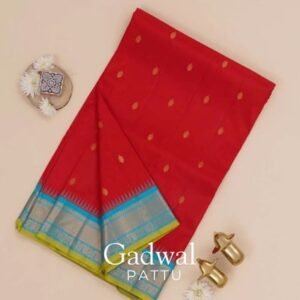
The traditional Gadwal is a “Sico” saree—a Cotton body with a Silk border. This unique combination was designed so the wearer stays cool in the heat (cotton) while looking festive (silk). However, modern “Pure Gadwal” versions are now made entirely of silk, known for their contrasting colors and heavy South Indian temple borders.
11. Tussar Silk
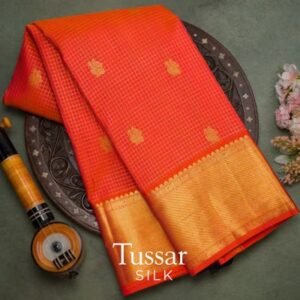
Tussar, or “Wild Silk,” is harvested from silkworms that live in the wild rather than on mulberry trees. It has a deep gold, copper-like natural sheen and a slightly coarse, textured feel. It is often used as a canvas for Madhubani paintings or heavy embroidery because of its sturdy nature.
12. Patola Pattu
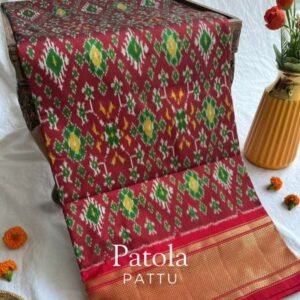
One of the most expensive sarees in the world. A genuine Rajkot or Patan Patola uses a Double Ikat weave where both the horizontal and vertical threads are tie-dyed. The process is so complex that a single saree can take 6 months to a year to weave. They are reversible and the colors never fade, even after 100 years.
13. Uppada Jamdani
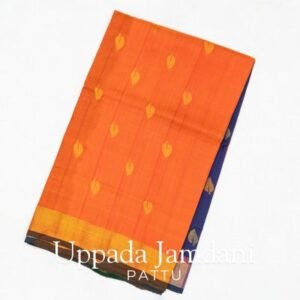
Uppada sarees are prized for being transparent and lightweight yet extremely grand. They use the ancient Jamdani technique, where the gold motifs are woven manually into the fabric thread-by-thread. It can take two weavers nearly two months to finish a single masterpiece.
Zari Quality:
Now, let’s look at the different types of Pattu sarees based on the quality and the material of the Zari used.
14. Pure Gold Zari (Suddha Zari)
This is the gold standard for heirlooms. It consists of a silk core, wrapped with a flattened silver wire, which is then electroplated with pure 24k gold. Over time, this zari develops a vintage patina rather than fading. You can learn the expert methods to identify real gold zari to ensure you are buying an authentic masterpiece.
15. Half-Fine Zari
Created for the modern, budget-conscious market, half-fine zari replaces the silver core with copper. The copper wire is then polished with gold. It looks identical to pure zari initially but is significantly cheaper and lighter in weight.
16. Tested Zari
Commonly found in budget powerloom sarees, this contains no precious metals. It uses synthetic fibers or copper coated with chemicals to mimic the shine of gold. It is prone to darkening or losing its luster over a few years.
17. Copper Zari
A major contemporary trend in Tamil Nadu. Instead of gold plating, the pure copper wire is left with its natural reddish hue. This creates a “Rose Gold” or antique copper finish that appeals to younger generations seeking a modern twist on tradition.
Weaving Techniques:
Now, let’s look at the different types of Pattu sarees based on the specific weaving methods and techniques used to create them.
18. Kuttu Border (Korvai)
The hallmark of authenticity. Two weavers work on a single loom—one for the body and one for the border. They are joined in a labor-intensive interlocking weave that creates a distinct, sharp color contrast.
19. Double Warp (Vaira Oosi)
Translating to “Diamond Needle,” this refers to a weave using double silk strands. It creates a thick, “Vaira Oosi” (fine needle-like) texture on the body that shimmers when the light hits it.
20. Petni
PA specialized technique used to merge a differently colored pallu into the body. The weaver skillfully ties the new colored threads to the existing warp to ensure the transition is seamless and strong.
21. Jacquard Weave
This utilizes a Jacquard attachment on the loom to create complex, floral, and leafy patterns across the entire body of the saree, often seen in “Modern Pattu” designs.
22. One-Side Border (Single Border):
A traditional style where the saree has one very wide, grand border at the bottom and a very thin or no border at the top. This makes the wearer look taller and is a signature of Thirubuvanam and Thanjavur silks.
Handloom vs. Powerloom
The main difference lies in craftsmanship versus mass production.
Handloom (Kai Thari): Woven manually by an artisan. It is more breathable, durable, and holds higher “heirloom” value. You can spot it by the slightly uneven edges (selvage) and the Korvai (interlocked) join between the border and the body.
Powerloom: Driven by machines. The fabric is perfectly uniform and stiff but lacks the strength of hand-woven silk. The border is usually printed or woven as a single piece rather than interlocked, making it cheaper but less traditional.
Conclusion
Buying a Pattu saree isn’t just about shopping; it’s about owning a piece of our culture. Whether you pick a heavy Kanchipuram or a light Arani silk, you are carrying forward a tradition that has lasted for centuries. Once you know the difference in Zari and where each saree is made, you can choose a masterpiece that will stay in your family for generations.










Pingback: Differences Between Silk Saree and Wedding Silk Saree