
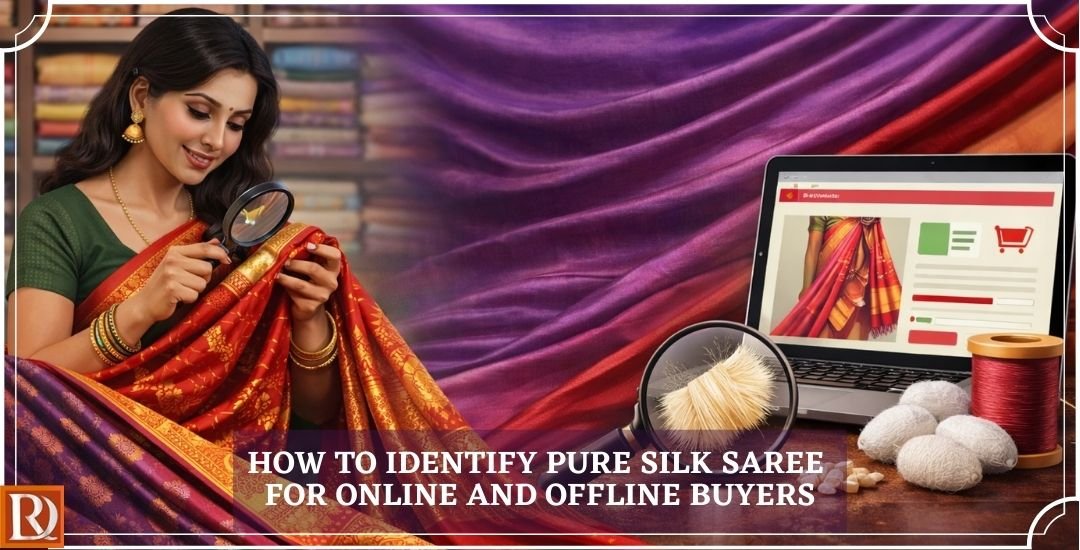
If you are planning to buy a pure silk saree, knowing how to distinguish genuine fabric from synthetic imitations is essential. A high-quality silk saree is a timeless investment, but the market is often flooded with “Art Silk” that mimics the look of the real thing. To ensure you get the best value for your money, this guide focuses on the specific steps you need to take to verify the authenticity of a silk saree, whether you are shopping at a local boutique or browsing through an online store.
How to Identify Pure Silk Saree When You Buy Online
When you cannot touch or feel the fabric, you must rely on visual certifications and seller transparency.
1. Silk Mark Organisation of India (SMOI) Label
This is the primary gold standard. Look for the “Silk Mark” butterfly logo in the product image gallery. It is a quality assurance label managed by the Central Silk Board.
2. Hologram and Serial Number Verification
Every genuine Silk Mark tag has a high-security hologram and a unique 4-to-8 digit alphanumeric serial number. You can verify these details using the official Silk Mark mobile app to see if the seller is a registered authorized user.
3. Detailed Product Specifications
Check the “Fabric” or “Material” section. A genuine seller will list the specific purity grade (e.g., 100% Mulberry Silk, Kanchipuram Silk, Thirubuvanam Silk). Be wary of vague terms like “Silk Blend,” “Poly Silk,” or “High-quality Silk-like fabric.”
4. Magnified View of Weave Irregularities
Zoom into the high-resolution photos. Pure handloom silk often shows very slight, natural irregularities in the weave (slubs). If the weave looks perfectly uniform and “plastic-smooth,” it is likely machine-made synthetic.
5. Price Benchmark Comparison
Pure silk is expensive due to the labor-intensive sericulture process. If a “Pure Kanchipuram” or “Thirubuvanam” is priced at a “too good to be true” rate (e.g., ₹1,500–₹4000), it is almost certainly artificial.
6. Seller Authenticity and Reputation
Research the seller’s history. Look for reviews specifically mentioning the “purity” or “feel” of the silk. Authorized handloom cooperatives are generally the safest online sources.
7. Return Policy for Purity Discrepancies
Always check if the seller allows returns if the fabric fails a purity test upon arrival. Genuine sellers usually stand by their product’s authenticity.
How to Identify Pure Silk Saree When You Buy Offline
If you are at a physical store, you have the advantage of using your senses to test the fibers.
1. The Burn Test
This is the most foolproof method. Pull a single thread from the warp and weft. Light it with a flame.
-
Pure Silk: Smells like burning hair, burns slowly, and leaves a crisp, black ash that turns to powder when touched.
-
Synthetic: Smells like burning plastic, melts/drips, and leaves a hard, uncrushable plastic bead.
2. The Ring Test
Take a lightweight silk saree and try to pull it through a finger ring. Genuine silk is incredibly fine and flexible; it should slide through effortlessly. Synthetic silk is stiffer and will likely bunch up or snag.
3. The Rub/Friction Test
Rub the surface of the saree vigorously with your hand for a few seconds. Pure silk creates noticeable warmth due to natural friction. Synthetic silk remains cool to the touch regardless of how much you rub it.
4. Lustre and Sheen Shift
Hold the saree up to the light and move it. Pure silk has a “tri-angular” fiber structure that refracts light at different angles, causing the color/sheen to shift slightly. Synthetic silk has a flat, one-dimensional, metallic white shine.
5. Tactile Texture and Drape Feel
Pure silk feels soft, smooth, and slightly “crunchy” when squeezed. It drapes naturally over the body. Artificial silk often feels slippery, oily, or overly stiff.
6. Handloom Weave Imperfections
Turn the saree over. Hand-woven pure silk will have small floats (loose threads) or tiny knots where the weaver joined the yarn. Machine-made artificial silk is perfectly identical on both sides.
7. Zari Scraping
If the saree has zari (metallic thread), gently scratch it. Pure zari has a red or yellow silk thread core wrapped in silver/gold. Fake zari uses a white polyester or cotton core.
Conclusion
Identifying a pure silk saree requires a mix of digital verification and physical testing. When shopping online, your best defense is checking for the Silk Mark and verifying the seller’s credentials. When buying offline, don’t be afraid to use the burn or rub tests to confirm the fiber’s natural properties. By following these steps, you can confidently choose a saree that offers the unmatched elegance, durability, and rich texture that only natural silk can provide. Happy shopping!







Pingback: How to Wash a Silk Saree at Home: 2 Practical Methods